
World Cup a mosaic of the human experience
Lessons to be learned from team’s multicultural pursuit towards a common goal
Advertisement
Read this article for free:
or
Already have an account? Log in here »
We need your support!
Local journalism needs your support!
As we navigate through unprecedented times, our journalists are working harder than ever to bring you the latest local updates to keep you safe and informed.
Now, more than ever, we need your support.
Starting at $15.99 plus taxes every four weeks you can access your Brandon Sun online and full access to all content as it appears on our website.
Subscribe Nowor call circulation directly at (204) 727-0527.
Your pledge helps to ensure we provide the news that matters most to your community!
To continue reading, please subscribe:
Add Brandon Sun access to your Free Press subscription for only an additional
$1 for the first 4 weeks*
- Enjoy unlimited reading on brandonsun.com
- Read the Brandon Sun E-Edition, our digital replica newspaper
*Your next Free Press subscription payment will increase by $1.00 and you will be charged $20.95 plus GST for four weeks. After four weeks, your payment will increase to $24.95 plus GST every four weeks.
Read unlimited articles for free today:
or
Already have an account? Log in here »
On June 13, the third day of the ongoing World Cup, Morocco played more than a quarter of its Group C match against Brazil without a single Moroccan-born footballer on the pitch.
Instead, the starting eleven deployed by manager Mohamed Ouahbi between the 64th and 89th minutes included players from Belgium, France, Spain, the Netherlands and Canada. (Goalkeeper Yassine Bounou was born in Montreal.) Ouahbi, himself, hails from metropolitan Brussels.
According to the BBC, nearly 25 per cent of the players at this tournament were born in countries other than the ones they’re representing.
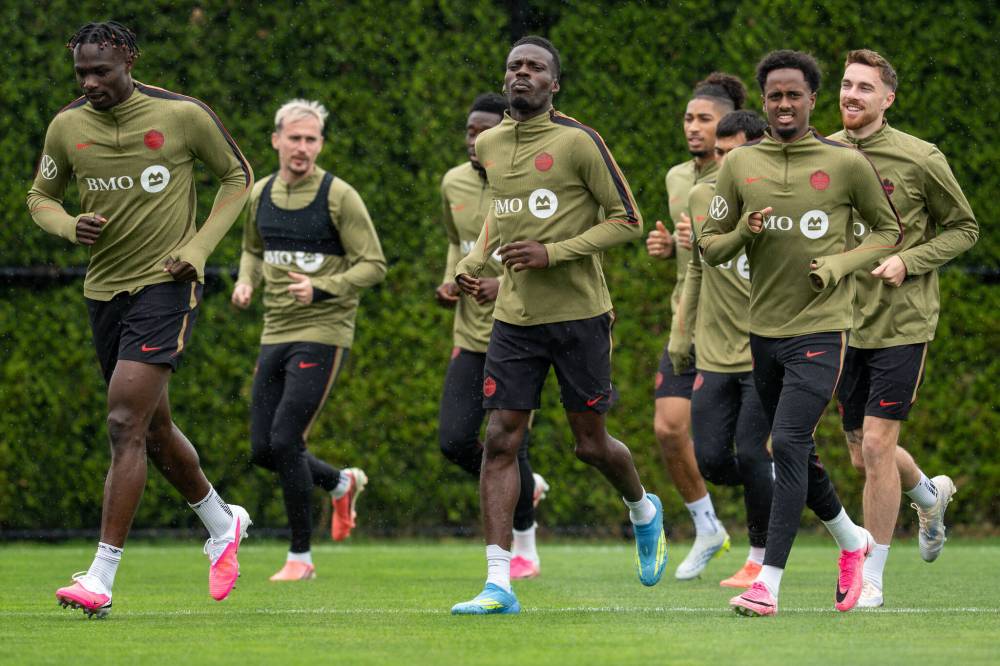
ETHAN CAIRNS / THE CANADIAN PRESS
Just eight of the World Cup’s 48 teams entirely native-born. From left: Brampton’s Promise David, Nigerian-born, Mississauga product Tani Oluwaseyi, Toronto product Ali Ahmed and Langley, B.C., product Joel Waterman practise at Team Canada’s Friday camp.
One of the more prominent examples of this experience is Luca Zidane.
Son of the iconic Zinedine Zidane, Luca was born in Aix-en-Provence but back-stops Algeria. How he came to play for Les Fennecs instead of Les Bleus — with which his father won the World Cup in 1998 — explains at least some of a phenomenon that might seem remarkable but is really anything but.
In 1953, Luca’s paternal grandfather, born in Algeria, moved to France in search of work. The North African country was a French colony at the time, but in barely a year the Algerian Revolution was underway. At its successful conclusion, almost a million European-Algerians crossed the Mediterranean to France.
It’s a template that can be applied — not with exactitude, of course — to many colonial scenarios of the 20th and 21st centuries.
Morocco, for its part, was partitioned between France and Spain in the early 1900s. And Curaçao, population 158,000, qualified for the 2026 World Cup through the efforts of mostly Dutch-born players. The island nation is still a constituent of the Netherlands.
As far as football is concerned, in 2004 FIFA extended international recognition to a third generation. In other words, if a player’s grandparent had been born elsewhere, the player was allowed to represent that country.
Additionally, players who met this criteria became eligible to switch international allegiance between youth and senior levels.
Luca Zidane took both paths. Through his grandfather, he was a prospective Algeria goalkeeper; although he played his underage football for France, he switched countries last September.
It’s a common enough story, but it’s not the only one. Just eight of the World Cup’s 48 teams are entirely native-born. There’s something else going on here, as well. Something bigger.
Globally, we are in the midst of a migration period of unprecedented proportion.
That term “migration period” is helpful in understanding what’s going on, as it points to the movement of entire peoples into Western Europe between the third and sixth centuries. Until relatively recently, those movements were crudely known as the “barbarian invasions.”
Only, the latter designation never really went away.
It has since been repurposed to describe (using other derogatory descriptors like “horde,” “mass,” “mob,” “caravan,” etc.) modern migrations by nativist governments and commentators of the far right — those adherents of “white replacement theory” and other repulsive worldviews who’ve become ever bolder in the current political climate.
The fact is, humans have always been on the move — whether to flee oppression, escape a climate event or simply because they wanted to. Tragically, they have also left one place for another because they were forced to do so.
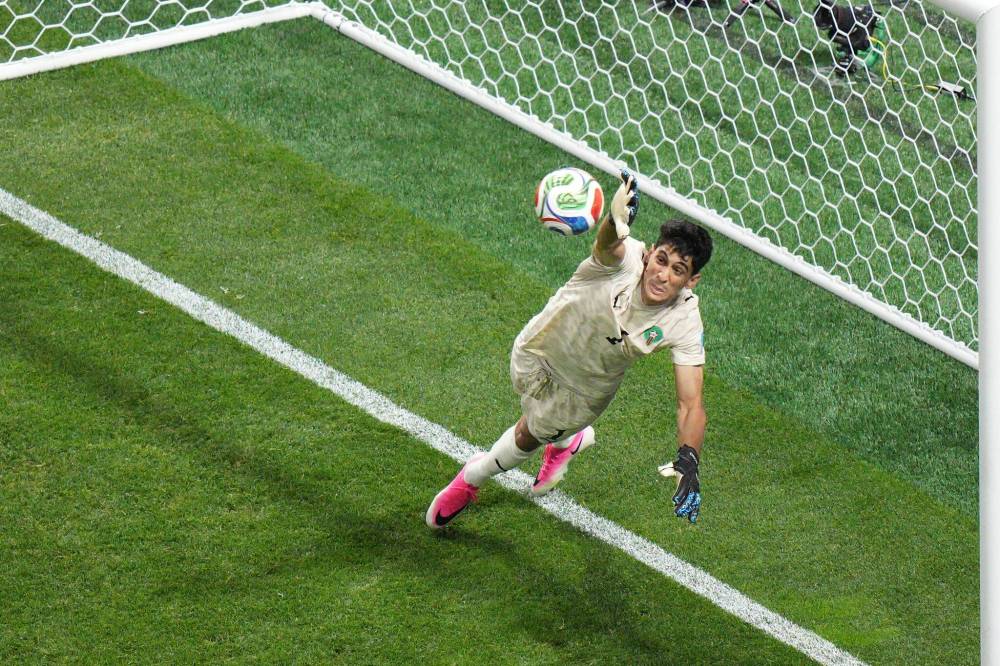
JACOB KUPFERMAN / THE ASSOCIATED PRESS
Morocco’s goalkeeper Yassine Bounou was born in Montreal.
Consider the make-up of the Canadian men’s national team.
Captain Alphonso Davies was born a Liberian refugee in Ghana and arrived in Edmonton as a child. Tani Oluwaseyi was born in Nigeria and moved to Mississauga when he was 10. Jonathan David was born in the U.S. to Haitian parents and eventually migrated to Ottawa.
The squad also includes players born in England and Ivory Coast, and then there are the ones from Nova Scotia in the east to B.C. in the west, and a number of places in between. Manager Jesse Marsch is an American who proudly sings this country’s anthem.
It’s a pretty accurate picture of Canada. And the World Cup is a good reflection of the make-up of, well, the world.
History shows us that countries — their borders and internal demographics — are essentially snapshots in time, prone to produce a different image as times change. This tends to scare people. It needn’t. It’s hardly new.
Human movement has always shaped societies; commonalities of place have always been in flux. How we navigate this reality tells us much about who we are.
Today, as the group stage concludes, a DR Congo side largely assembled from a diaspora will look to book a place in the Round of 32 by beating a Uzbekistan outfit whose players work in England, Iran, Turkey and the United Arab Emirates. Austria, which is captained by a Vienna-born son of Philippine and Nigerian parents, will face Luca Zidane and Algeria.
And Morocco, whose group stage wrapped up on Wednesday, will take on Canada in the Round of 16 if both countries win their first knockout matches.
These squads, like most, are comprised of stories as varied and numerous as the people who play for them. What this tournament does is show them coming together in pursuit of a common goal.
Yes, a global event like the World Cup inevitably reflects the human experience back at us. But maybe it can teach us something, too.
winnipegfreepress.com/jerradpeters