
Grad numbers down, but still second highest
Advertisement
Read this article for free:
or
Already have an account? Log in here »
We need your support!
Local journalism needs your support!
As we navigate through unprecedented times, our journalists are working harder than ever to bring you the latest local updates to keep you safe and informed.
Now, more than ever, we need your support.
Starting at $15.99 plus taxes every four weeks you can access your Brandon Sun online and full access to all content as it appears on our website.
Subscribe Nowor call circulation directly at (204) 727-0527.
Your pledge helps to ensure we provide the news that matters most to your community!
To continue reading, please subscribe:
Add Brandon Sun access to your Free Press subscription for only an additional
$1 for the first 4 weeks*
- Enjoy unlimited reading on brandonsun.com
- Read the Brandon Sun E-Edition, our digital replica newspaper
*Your next Free Press subscription payment will increase by $1.00 and you will be charged $20.95 plus GST for four weeks. After four weeks, your payment will increase to $24.95 plus GST every four weeks.
Read unlimited articles for free today:
or
Already have an account? Log in here »
A total of 671 Brandon School Division students graduated in June — and while that’s a decline from the 726 who graduated in 2025, it’s still the second-largest graduating class recorded in the division.
The numbers, which were presented to the board of trustees Monday evening, include all graduates, including those who took more or less than four years to finish high school.
The 2026 statistics include 488 students who completed high school within four years, 33 who took five years, 10 who took six years, nine who took seven years, and three who graduated early. Another 128 had transferred into the division after beginning their high school education elsewhere.
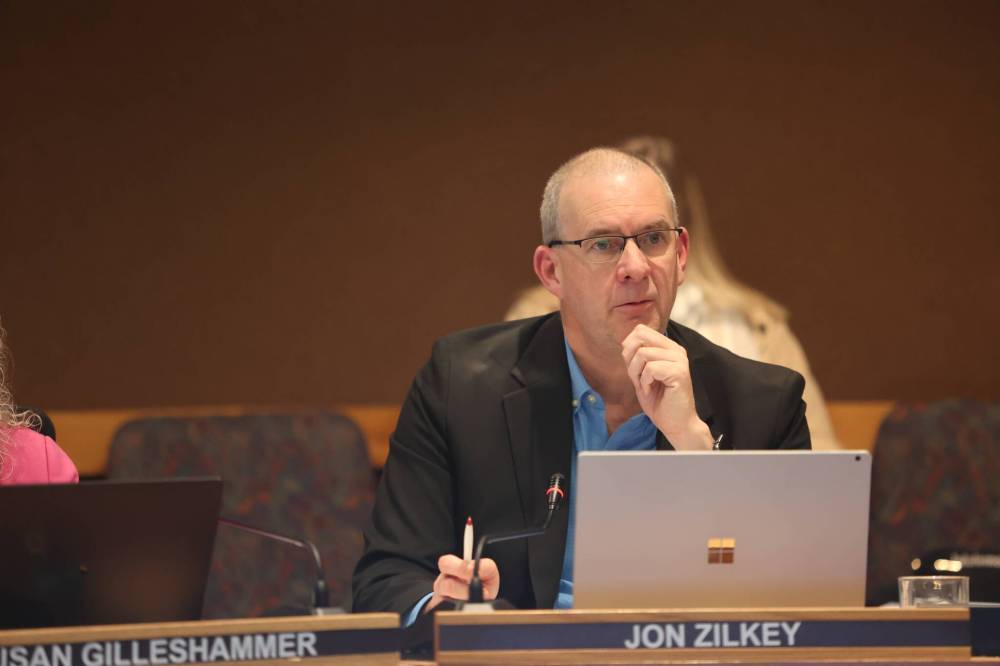
Brandon School Division Supt. Jon Zilkey presents the report on the 2026 graduation rate to the board of trustees Monday evening. A total of 671 students graduated in June, the second-largest graduating class recorded in the division. (Photos by Abiola Odutola/The Brandon Sun)
The report from administration showed that the four-year graduation rate for the 2022 cohort, which began with 695 Grade 9 students, was 80 per cent — slightly below the 83.3 per cent recorded for the 2021 cohort, Supt. Jon Zilkey told the board.
The cohort graduation rate tracks students from the year they enter Grade 9, excluding those who move out of the division or are otherwise removed from the cohort under the reporting methodology, he said.
Despite the slight decline, Zilkey said the division’s results had remained relatively steady over the reporting period.
The report also examined graduation outcomes for students learning English as an Additional Language (EAL) and Indigenous students.
EAL students, the report stated, continued to record four-year graduation rates above the division’s overall average, with approximately 80 to 90 per cent graduating within four years.
Trustee Jim McCrae pointed to the performance of EAL students, particularly those who enter the school system with limited English-language skills.
“Am I correct that the EAL students have a better graduation rate than everybody else, and many of these students enter the system with very poor English?” McCrae asked.
Zilkey confirmed the observation, saying EAL students had consistently recorded slightly higher graduation rates.
“We get EAL students from a variety of areas, but yes, they’re consistently slightly higher,” he said.
McCrae also asked when students stopped being classified as EAL, given that many acquire English-language skills during their earlier school years.
Zilkey said while funding for EAL students had been reduced from four years to three, the division continued tracking them beyond their funding eligibility.
“We keep them drafted EAL even though we’re not funding them anymore,” he said.
Indigenous student graduation outcomes, however, remained an area of concern.
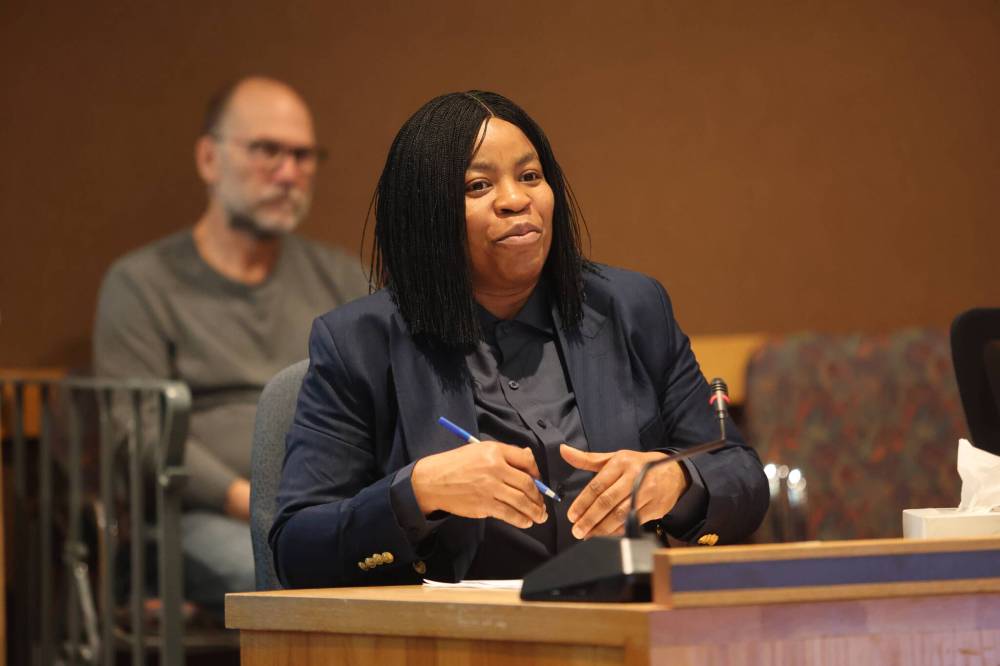
LEFT: Brandon School Division research and evaluation analyst Funmilayo Oluwafemi tells the school board that the report showed an increase in the number of Indigenous students graduating from BSD, from 77 in 2021 to more than 100 annually between 2023 and 2025, before dropping to 93 in 2026.
The four-year graduation rate declined to 44 per cent for the 2022 cohort, compared with 50 per cent in the previous reporting year, Zilkey said.
Zilkey cautioned trustees against placing too much emphasis on a single year’s results but said the overall rate remained concerning.
“I’m more unhappy with the number being as low as it is,” he said.
The report showed an increase in the number of Indigenous students graduating from BSD, from 77 in 2021 to more than 100 annually between 2023 and 2025, before dropping to 93 in 2026, BSD research and evaluation analyst Funmilayo Oluwafemi said.
“Indigenous students accounted for approximately one in seven BSD graduates, with between 42 and 52 per cent graduating within four years,” she told the board. “More Indigenous students were completing high school when given additional time.”
The division’s longer-term graduation figures showed that approximately 90 per cent of students graduated when given up to two additional years beyond the standard four-year period.
Oluwafemi said the overall results demonstrated that most students were completing high school within four years, while additional time helped more students achieve graduation.
» aodutola@brandonsun.com
» X: @AbiolaOdutola