
U of M adds capacity to emergency medicine program for family doctors
Advertisement
Read this article for free:
or
Already have an account? Log in here »
We need your support!
Local journalism needs your support!
As we navigate through unprecedented times, our journalists are working harder than ever to bring you the latest local updates to keep you safe and informed.
Now, more than ever, we need your support.
Starting at $15.99 plus taxes every four weeks you can access your Brandon Sun online and full access to all content as it appears on our website.
Subscribe Nowor call circulation directly at (204) 727-0527.
Your pledge helps to ensure we provide the news that matters most to your community!
To continue reading, please subscribe:
Add Brandon Sun access to your Free Press subscription for only an additional
$1 for the first 4 weeks*
- Enjoy unlimited reading on brandonsun.com
- Read the Brandon Sun E-Edition, our digital replica newspaper
*Your next Free Press subscription payment will increase by $1.00 and you will be charged $20.95 plus GST for four weeks. After four weeks, your payment will increase to $24.95 plus GST every four weeks.
Read unlimited articles for free today:
or
Already have an account? Log in here »
WINNIPEG — Manitoba is training more family doctors in emergency medicine to help strengthen the pipeline of emergency physicians for communities across the province.
Health Minister Uzoma Asagwara announced Wednesday that the University of Manitoba is increasing the number of annual training seats to 17 from 11. The family medicine enhanced skills program provides physicians with an additional year of specialized emergency medicine training after completing a family medicine residency.
“Emergency physicians do incredibly important work for Manitobans and we need more of them,” Asagwara said at a news conference at University of Manitoba’s Health Sciences Centre campus.
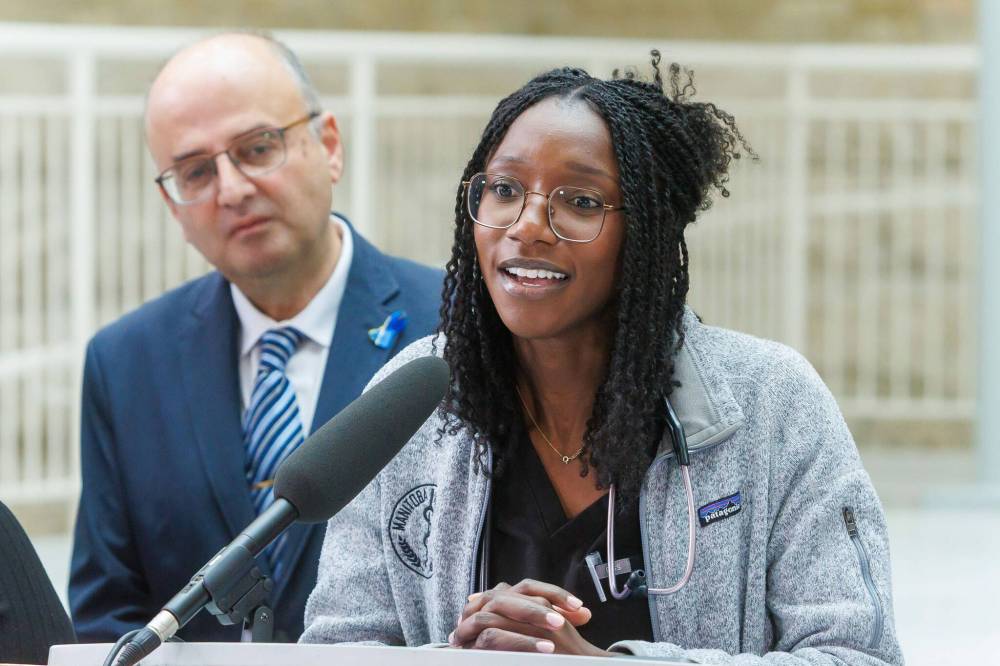
Tobi Morakinyo, a resident in the College of Family Physicians of Canada emergency medicine training program, has expanded her skills by working in northern Manitoba communities. (Mike Deal/Winnipeg Free Press)
The province is investing in training more doctors, providing more physicians with the opportunity to build their careers in Manitoba and strengthening the workforce that emergency departments rely on, the minister said. The 17 residents began their training on July 1.
“Manitobans are waiting too long in our emergency departments, and the folks delivering care are under too much pressure,” Asagwara said.
Tobi Morakinyo, one of the residents in the College of Family Physicians of Canada emergency medicine training program, said she has expanded her skills working in northern communities, including St. Theresa Point, Norway House, Flin Flon and Thompson.
“In those sites you see how much of a need there is and you learn how to be a resourceful physician providing care to those in need. It’s been very rewarding,” said Morakinyo, who has spent the last 14 years in Manitoba studying nursing at the U of M, working at HSC and then returning to study medicine.
“This plus-one year for me was really important to try and gain some of those skills so I can provide safe and competent care for everybody in Manitoba.”
Asagwara said the NDP government is also actively recruiting more physicians to improve ER staffing ratios to make sure that the rising volume of patients, many with increasingly complex illnesses, can be “addressed in the best way possible.”
Dr. Shawn Young, HSC’s chief medical officer, said that increasing the number of family doctors trained in emergency medicine helps strengthen the health-care system.
“We’ve got these big nation-building projects going on — building pipelines, improving our foundation. That’s what this is doing for us in Manitoba — it’s improving our pipelines,” Young said.
Increasing the ER workforce will relieve some of the pressure on emergency physicians and help to retain them, he said.
“If you’ve got more folks around you with that skill set supporting you, you don’t feel as alone. You have more providers to be able to provide the care and keep these emergency departments open, keep the urgent cares open,” Young said.
Rotating ER closures throughout the province are the result of not enough having enough ER physicians, he said.
“That just drives everybody to the city,” he said.
He pointed to examples of Winnipeg residents travelling to rural hospitals in an attempt to avoid long city ER waits.
“If we can keep those emergency departments, urgent cares open, that gives people more options for much more timely care, and you’re not concentrating all that activity in just a few places,” Young said.
Physicians advocacy organization Doctors Manitoba said in a statement that the increased number of family doctors getting emergency medicine training is a step toward better long-term physician coverage in ERs.
Asagwara said the NDP government, three years into its mandate, is building up capacity that was cut by the previous Progressive Conservative government.
“The greatest threat to health care in Manitoba is if there were ever to be a PC government in power again,” Asagwara said. “We need to make sure that our government remains in place so we can keep investing in health care, keep working with our partners as one Team Manitoba, and keep investing in health care as our top priority.”
The next provincial election must be held on or before Oct. 5, 2027.
Rather than focusing on partisanship, the NDP should be dealing with “this ever-deepening health-care crisis,” PC health critic Kathleen Cook said.
“The NDP seem to be more concerned with the next election than they are with the state of health care right now,” said the Roblin MLA. “I think it’s worth noting that since the NDP took office, median wait times have doubled, diagnostic wait times have doubled and tripled and, in some cases, even quadrupled. Last year, service delays were a contributing factor in over 30 per cent of critical incident deaths.”
» Winnipeg Free Press