
Environmental groups question Kinew’s Churchill ambitions
Advertisement
Read this article for free:
or
Already have an account? Log in here »
We need your support!
Local journalism needs your support!
As we navigate through unprecedented times, our journalists are working harder than ever to bring you the latest local updates to keep you safe and informed.
Now, more than ever, we need your support.
Starting at $15.99 plus taxes every four weeks you can access your Brandon Sun online and full access to all content as it appears on our website.
Subscribe Nowor call circulation directly at (204) 727-0527.
Your pledge helps to ensure we provide the news that matters most to your community!
To continue reading, please subscribe:
Add Brandon Sun access to your Free Press subscription for only an additional
$1 for the first 4 weeks*
- Enjoy unlimited reading on brandonsun.com
- Read the Brandon Sun E-Edition, our digital replica newspaper
*Your next Free Press subscription payment will increase by $1.00 and you will be charged $20.95 plus GST for four weeks. After four weeks, your payment will increase to $24.95 plus GST every four weeks.
Read unlimited articles for free today:
or
Already have an account? Log in here »
WINNIPEG — Environmental groups are calling the Manitoba government contradictory for promoting both Earth Day and possible liquefied natural gas shipments through the Port of Churchill.
“We think it’s quite hypocritical, and it just doesn’t line up,” said James Wilt, Climate Action Team Manitoba’s policy development manager.
He attended an Earth Day celebration at the Manitoba legislature this week. The ceremony was packed with cabinet ministers and environmentalists.
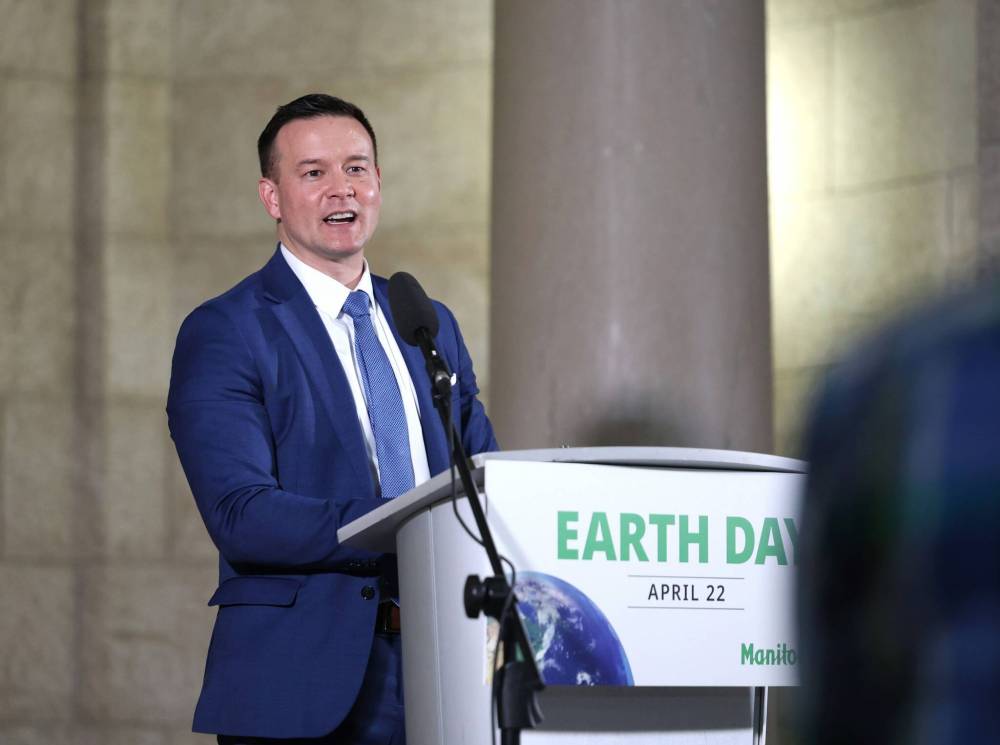
Environment and Climate Change Minister Mike Moyes announces new funding toward climate-related concerns during Earth Day celebrations at the legislature building Wednesday. (Ruth Bonneville/Winnipeg Free Press files)
Premier Wab Kinew’s goal of shipping LNG through the port by 2030 stands in “stark contrast” to the government’s stated commitments to climate change, Wilt said.
Kinew told reporters last week he and Prime Minister Mark Carney share the same export vision. Kinew has also mused about a pipeline to ship energy from Western Canada.
Wilt expressed concern about gas leakage and company practices at refineries and export terminals, including flaring — natural gas burning.
“It has really enormous climate, but also local air pollution effects,” Wilt said. “We just think that this really risks wiping out any supposed climate benefits of using gas, in terms of this supposed transition fuel away from coal.”
James Beddome, executive director of the Manitoba Eco-Network, expressed skepticism about Kinew’s 2030 timeline.
The former Green Party of Manitoba leader called environmental laws “not adequate” to assess a pipeline project. The process to improve those laws will take years, he said.
Feiyue Wang, a University of Manitoba researcher, has been studying climate change effects on Hudson Bay and how fewer days of frozen waters will impact shipping.
The results are before the provincial government. They’ll be shared once published in a peer-reviewed journal.
Shipping LNG through the port by 2030 is “extremely ambitious, if at all possible,” Wang said.
“You have to really get Indigenous and community folks involved from the very beginning, making sure that their concerns … are looked after,” he said.
More research is needed to understand the environmental impact and how to mitigate potential risks, added Wang, who heads the Churchill Marine Observatory.
He — alongside fellow researchers in Churchill and Kivalliq — submitted a proposal to government in 2024 to assess how Hudson Bay’s changing conditions and more traffic on the water would affect the environment and health of surrounding communities. Funding hasn’t yet been granted, Wang said.
“The opportunities that we face in front of us are unprecedented,” he said, citing improved accessibility that would lower local residents’ cost of living.
“(But) if we’re not funding these kinds of studies, this kind of research — especially if we’re not getting folks engaged right now, from the very beginning — I don’t think 2030 is feasible at all.”
Environment Minister Mike Moyes pointed to ongoing studies on private-sector interest and expanding the port’s shipping season. The University of Manitoba and Arctic Research Foundation are now researching the deployment of icebreakers and other tools to bolster year-round shipping.
Moyes mentioned a potential National Marine Conservation Area in the western part of Hudson Bay; its feasibility is being assessed. The provincial and federal governments are also trying to designate the Seal River watershed, a 50,000-square-kilometre space, an Indigenous protected and conserved area.
The ecosystem is just west of Hudson Bay.
“It’s not a battle between the economy and the environment. You can do both,” Moyes said, adding government can be “efficient while at the same time being thorough.”
Manitoba’s Environment and Innovation departments are working together on technology to support the port’s expansion, Moyes said without elaborating.
He announced $770,000 Wednesday for three environment-focused organizations — Eco-West Canada, the University of Winnipeg’s Prairie Climate Centre and ClimateWest.
Both Beddome and Wilt said the amount of money is inadequate. Wilt is waiting for the province to act on its Path to Net Zero plan commitments; the document came out in October.
“We just don’t get the sense that the province is prioritizing the climate crisis nearly as much as it’s prioritizing this plan to export LNG out of Churchill,” he said.
Climate action plans will appear by the end of spring, Moyes said. The province has also launched a 13-member youth advisory council that will collaborate with its expert advisory council on upcoming climate plans, he said.
Tory Leader Obby Khan earlier this week questioned the province’s goal of shipping LNG through the port by 2030. Government hasn’t yet formed the Manitoba Crown-Indigenous Corp., which is supposed to lead major economic development projects including the Port of Churchill expansion, he said, adding consultations and further construction could take years.
The path to expand the port must balance “economic opportunity, environmental responsibility and Indigenous rights and partnership,” Chris Avery, president of Arctic Gateway Group, said in a statement.
Arctic Gateway Group owns the deep-water port.
» Winnipeg Free Press