
Trial pits animal-welfare group against horse exporter
Advertisement
Read this article for free:
or
Already have an account? Log in here »
We need your support!
Local journalism needs your support!
As we navigate through unprecedented times, our journalists are working harder than ever to bring you the latest local updates to keep you safe and informed.
Now, more than ever, we need your support.
Starting at $15.99 plus taxes every four weeks you can access your Brandon Sun online and full access to all content as it appears on our website.
Subscribe Nowor call circulation directly at (204) 727-0527.
Your pledge helps to ensure we provide the news that matters most to your community!
To continue reading, please subscribe:
Add Brandon Sun access to your Free Press subscription for only an additional
$1 for the first 4 weeks*
*Your next subscription payment will increase by $1.00 and you will be charged $20.00 plus GST for four weeks. After four weeks, your payment will increase to $24.00 plus GST every four weeks.
Read unlimited articles for free today:
or
Already have an account? Log in here »
WINNIPEG — A rare trial got underway in Winnipeg Thursday, as an animal-rights organization began to privately prosecute a Swan River-area farm over a 2022 shipment of horses it alleges violated the law.
Animal-rights organization Animal Justice took the rare step of obtaining judicial approval in 2024 to privately prosecute horse exporter Carolyle Farms over the Dec. 12, 2022 air shipment of 79 horses to Japan for slaughter, where the meat is sold raw as a culinary delicacy.
The charge, laid by Animal Justice executive director Camille Labchuk, alleges the company failed to have a sufficient contingency plan in place when the shipment was diverted from its planned rest stop in Alaska due to a snowstorm.
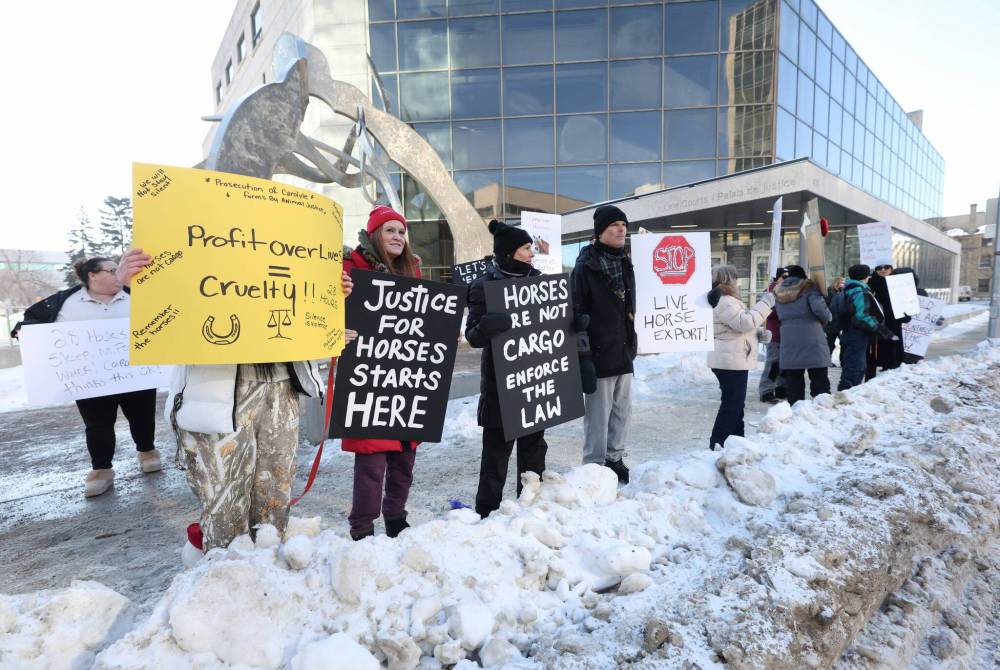
Animal rights activists rally in front of Winnipeg’s Law Courts on Thursday as a horse-export trial gets underway. (Ruth Bonneville/Winnipeg Free Press)
It landed to refuel in Seattle instead.
Federal legislation dictates live horses are allowed to be in transport without food and water for 28 hours. That time limit was exceeded by more than eight hours by the time the horses arrived at a quarantine facility in Japan, the animal-welfare organization argues.
Private prosecutor Dan Stein called three witnesses, all officials at the Canadian Food Inspection Agency who were involved in the export process, to testify in front of provincial court Judge Sandra Chapman on Thursday.
Among them was veterinarian Max Popp, who inspected the horses and was among those overseeing the loading process at the Winnipeg airport after the livestock arrived from Swan River.
He signed off on the transport plan — developed by the exporter and the transport company after they learned of the storm in Alaska — that saw the plane stop in Seattle. On paper, the amended trip was meant to take about 30 hours in total, Popp said.
He told court that plan was in the best of interest of the horses.
Erin Butterfield, who at the time was an inspection manager and acting director of operations at the Canadian Food Inspection Agency, told court she sent a letter to Carolyle Farms, telling the operator to review contingency plans to address issues such as the airport in Alaska being closed.
On cross-examination by defence lawyer Lindsay Mulholland, Butterfield told court that all parties involved were to have contingency plans in place, including the company that transported the animals, Sea Air International Forwarders.
Kaitlyn Mitchell, Animal Justice’s director of legal advocacy, said outside court that the trip, which the organization believes took more than 36 hours, was “egregious.”
“This shipment went over the limit by so long, we know that at least three horses collapsed, and we’re pleased that we finally have the opportunity to present in court and explain to the judge exactly what happened,” she said.
She argued that legislation dictates that the exporter — Carolyle Farms — is ultimately responsible for the welfare of the animals from beginning to end of the process.
If the court rules Carolyle Farms violated the legislation, Animal Justice will seek fines in the thousands of dollars, said Mitchell.
Farm owner Lyle Lumax has argued in the past the shipment followed best practices, with input on the ground from Canadian Food Inspection Agency officials, Japanese officials and the transport company.
Private prosecutions, which are rarely heard in the Canadian justice system, involve an individual — rather than authorities, such as police or the Crown — with evidence of reasonable and probable grounds asking the court to authorize a charge against someone they believe committed a crime. Prosecuting the crime follows.
The animal-welfare group had first complained to the inspection agency about the shipment, but when the regulator decided not to take any action, the organization began the private prosecution process.
The court proceedings are believed to be the first time a private prosecution involving farm animals has reached trial in Canada.
» Winnipeg Free Press