
On the front line of the fight to save Canada’s bats
Advertisement
Read this article for free:
or
Already have an account? Log in here »
We need your support!
Local journalism needs your support!
As we navigate through unprecedented times, our journalists are working harder than ever to bring you the latest local updates to keep you safe and informed.
Now, more than ever, we need your support.
Starting at $15.99 plus taxes every four weeks you can access your Brandon Sun online and full access to all content as it appears on our website.
Subscribe Nowor call circulation directly at (204) 727-0527.
Your pledge helps to ensure we provide the news that matters most to your community!
To continue reading, please subscribe:
Add Brandon Sun access to your Free Press subscription for only an additional
$1 for the first 4 weeks*
- Enjoy unlimited reading on brandonsun.com
- Read the Brandon Sun E-Edition, our digital replica newspaper
*Your next Free Press subscription payment will increase by $1.00 and you will be charged $20.95 plus GST for four weeks. After four weeks, your payment will increase to $24.95 plus GST every four weeks.
Read unlimited articles for free today:
or
Already have an account? Log in here »
On a cool July evening in the Northwest Territories, a team of young bat surveyors gathered at the base of a box where week-old bat pups had been spotted the night before.
As its name may indicate, a bat box is a human-made wooden habitat placed 10 feet or more above ground as an alternative roosting place for the animals, which sometimes like to find their way into cosy attics.
However, the scene here was bleaker than it had been the previous evening. Two pups looked to have died at the foot of their roost in the 24 hours since they were last seen.
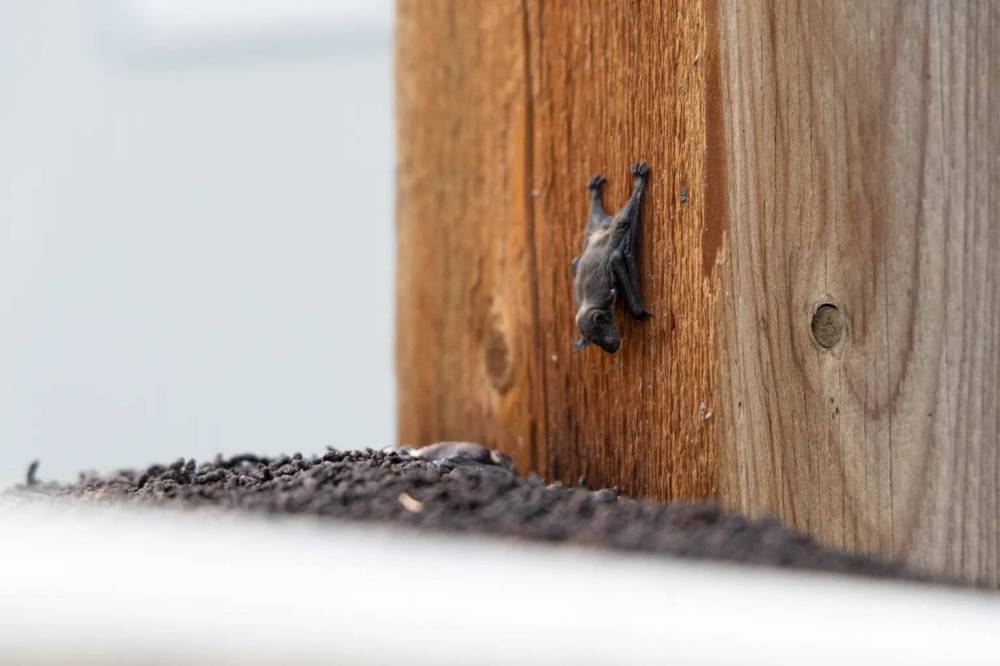
A tiny brown myotis pup is seen near the foot of its roost. (Photos by Claire McFarlane/Cabin Radio)
Disappointment lingered among the crew until suddenly, a flutter was spotted in a tiny chest cavity.
Rosie French, one of the surveyors, sprung into action with gloves, a mask and a cloth bag.
Ever so delicately, she scooped up the pup, placed it in the bag and tied it tight.
She placed the bag inside her jumpsuit, using her body heat to warm the tiny bat before placing it back into the roost later that evening.
Over two nights, a team of researchers outside Kakisa conducted a portion of their annual bat monitoring survey, an initiative operated by the Northwest Territories’ Department of Environment and Climate Change (ECC).
Researchers became temporarily semi-nocturnal, braving cold northern nights and swarms of mosquitoes to carry out their work.
That research is more important than ever. An existential threat to bats that had been looming for years landed on the N.W.T.’s doorstep earlier this year.
In May, researchers detected the first case of white nose syndrome in the territory, which ECC said was the northernmost detection of the disease in North America.
The disease, caused by a cold-loving fungus called Pseudogymnoascus destructans, has gradually made its way across the continent since it was first detected about 20 years ago.
It has decimated bat populations across North America. Researchers have reported population declines of 98 per cent at some roosting sites.
The fungus — sometimes referred to as Pd — disrupts bats’ hibernation by damaging their skin and causing an immune response. This makes them use their fat reserves (which would otherwise help get them through winter) to warm up their bodies.
Northern bats may be especially vulnerable to white nose syndrome due to their long hibernation cycles through cold winters. Now, researchers in the N.W.T. are using all of the available tools to try to protect them.
PUNCH TO THE GUT
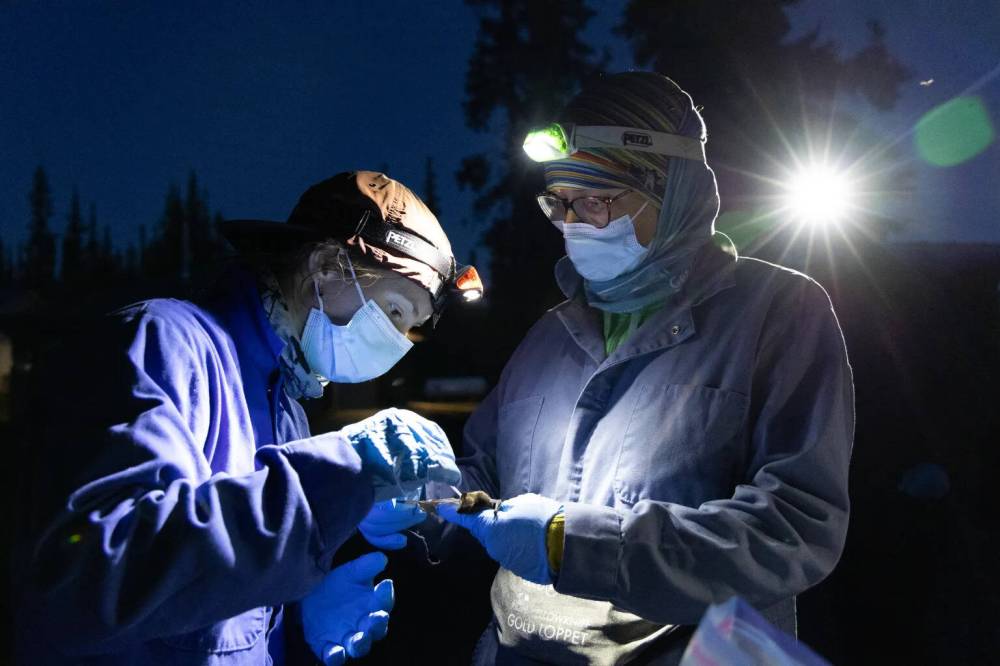
Jenaya Hanninen swabs the wing of a bat held by Joanna Wilson.
Joanna Wilson, a species at risk biologist with ECC, was on the team that discovered bats with visible signs of white nose syndrome near Fort Smith earlier this year.
“We’ve been watching white nose spread, knowing that it would get here eventually. I think we had an idea that we might find it when we went out this year because it had been detected in northern Alberta, but it’s still a punch to the gut to see that,” Wilson said.
“We did not find a whole bunch of dead bats when we went, so that was one positive thing. I think it remains to be seen whether that will continue to be the case or if it’s just because we got there early.”
Wilson said sick bats are tough to see, given the knowledge researchers have of devastation elsewhere. “I think all of us find it pretty heavy.”
For the first time this year, the researchers sprayed a protective “cocktail” at known roosting sites, in the hope it will help bats fight the disease.
The cocktail includes three species of bacteria already found on bats (though usually not together on the same bat). Each has shown what researchers describe as “anti-Pd activity.”
Wilson said the cocktail is an important part of the fight to protect bats but it isn’t the only possible solution. An oral vaccine is in development in the United States.
“The best thing we can do might turn out to be a combination of approaches,” Wilson said.
IMPORTANT YEAR FOR BATS
ECC has conducted annual bat monitoring at four maternity colonies in the N.W.T.’s South Slave region since 2019, Wilson said.
“That year, we did a big tour of the southern N.W.T., talking to people about who had bats living on their property and trying to get a sense of where bats were,” she said.
Researchers picked sites near Kakisa, Fort Smith, Hay River and Fort Providence to inspect annually.
On the first night at each location, field workers install themselves in front of a roost and, for an hour after the first bat exits, they count the number of bats that subsequently emerge.
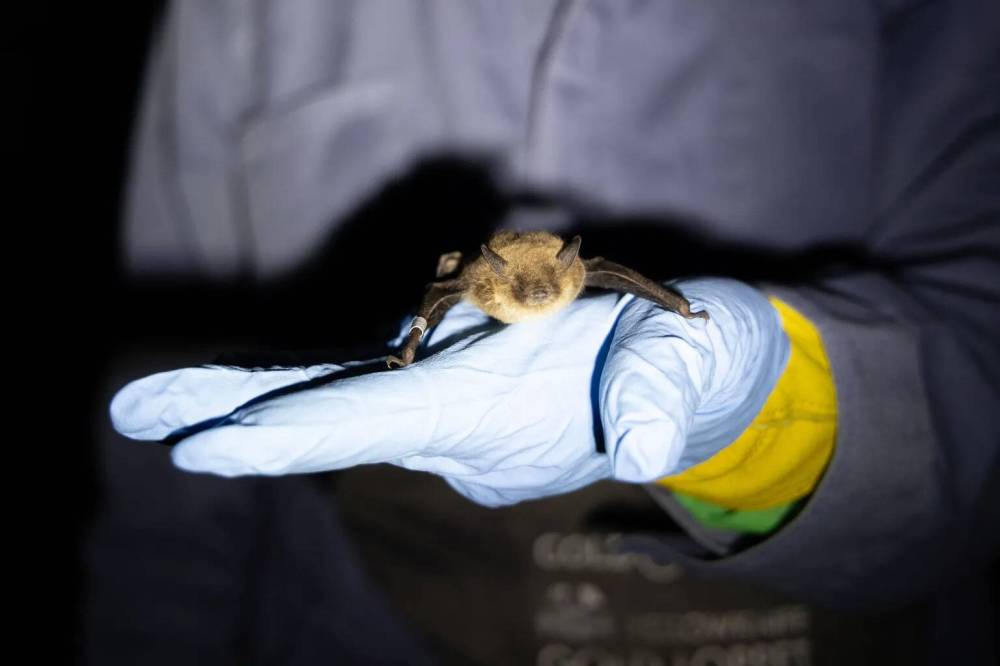
A bat lingers on Joanna Wilson’s hand.
Most of the little brown myotis bats being studied in Kakisa left their homes around dusk to begin their nightly hunt. (Some are said to eat half their body weight in insects in one evening.)
Before they emerged, the bats could be heard vocalizing to one another — a squeaking that sounds a little like a VHS tape being rewound.
For that hour, Joslyn Oosenbrug, who works with the N.W.T. Species at Risk Secretariat, sat with headphones on. She said listening to podcasts makes it easier to pass the time and keep her eyes focused on the bat boxes.
Normally, she said, her role doesn’t include much field work. Given this year is such an important one for the N.W.T.’s bats, she wanted to lend a hand.
The little brown myotis bats and northern myotis bats will be reassessed by the Species at Risk Committee in 2027. Oosenbrug said she wanted an opportunity to learn more about the animals by getting to see them up close.
That evening in Kakisa, researchers counted 168 adult bats — a good population size, Wilson said. “So far, everything has been within the usual range.”
THE ‘BEST PART’
Just before 10 p.m. on the second evening of the survey, the researchers set up mist nets near the boxes to capture bats as they left their roosts.
They delicately untangled the bats and placed them into soft cloth bags, moving with quiet urgency to minimize the time bats spent in the net.
Once 22 bats had been captured, the research team closed the nets and established a form of assembly line where Wilson removed each animal from their bag, listed off their sex, weight, forearm length and condition, the roundness of their teeth and whether or not they were pregnant or lactating.
Oosenbrug took note of every metric and the band number associated with each animal. This allows researchers to track the health, age and location of the bats year after year if they are recaptured.
Each bat moved down the assembly line to Sophie Clark, a wildlife technician intern, and summer student Jenaya Hanninen, who swabbed the bats’ wings. Those swabs are shipped to a lab at McMaster University in Ontario, where they will be tested for Pd.
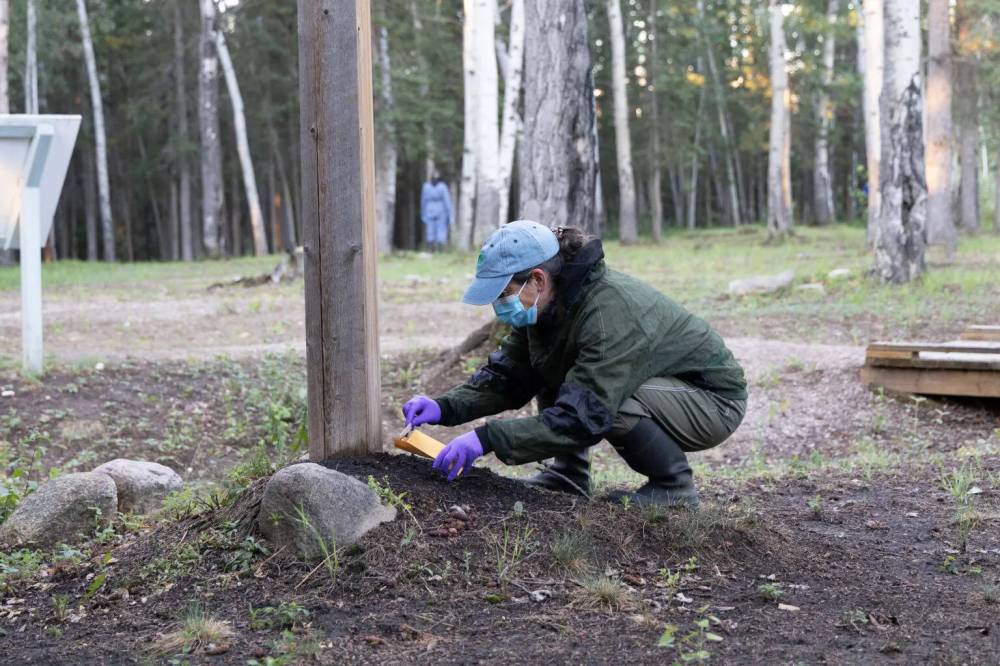
Joslyn Oosenbrug collects bat droppings, called guano, which will be tested for the fungus that causes white nose syndrome. She jokes that it’s an envelope she wouldn’t want to lick closed.
Wilson said the swabs also establish a baseline of bacteria present in the colony before bats are treated with the protective cocktail, helping to map the relationship between probiotic levels and Pd.
Lastly, bat by bat, Clark walked to the edge of the work area, raised her arm above her head and allowed each animal to fly away.
“The best part,” Oosenbrug observed.
As the night went on and temperatures dropped to around 12 C, some bats became too cold to fly away.
Placed back into their cloth bags, the bats were nestled into the front of researchers’ jackets to be warmed.
By just after 2 a.m., all 22 bats had been catalogued and released.
Wilson said the bats appeared healthy to the naked eye, with minimal wing tissue damage, but results from the swabs are likely to reveal more information.
After sanitizing their tools, bagging their external layers of clothing to be decontaminated (to prevent spreading Pd spores to new sites) and spraying down their boots, the researchers could finally call it quits and head back to their camp.
At 4 a.m., they went to bed. Of four nights, Oosenbrug later said, this was the earliest they finished.
IMPORTANT BUG EATERS
Over our two nights at the site, the researchers worked with a quiet but profound passion for the animals and their conservation.
When a pair of pups riddled with parasitic bat bugs was discovered near a roost, the cataloguing of healthy adult bats was put on hold so the pups could be tended to.
Meticulous care was put into carefully removing each and every bug to try to ensure the pups’ survival.
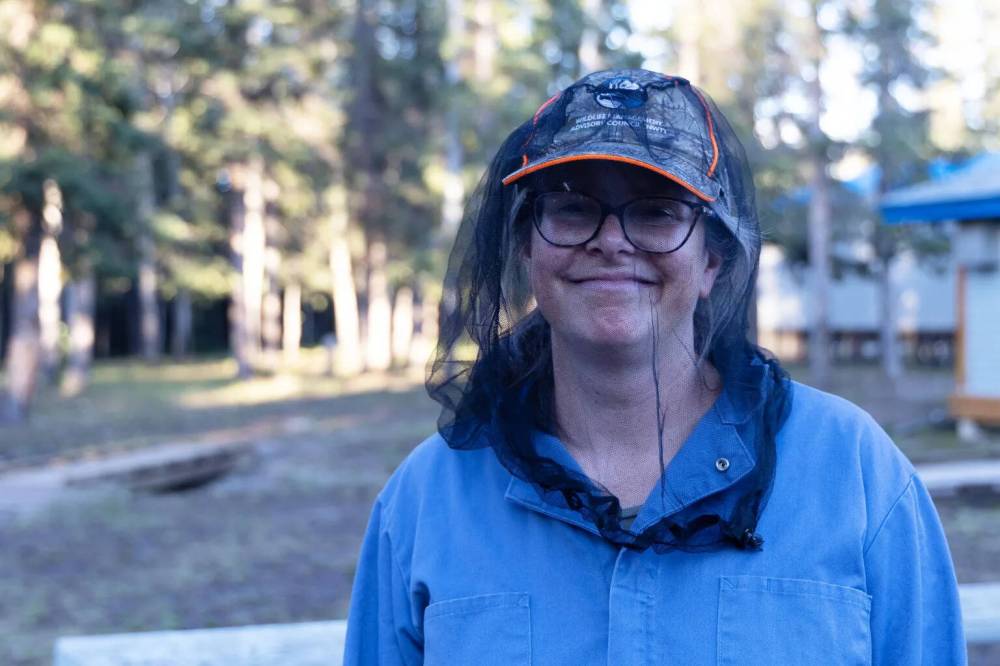
Species at risk biologist Joanna Wilson and the other researchers wore bug nets to protect themselves from mosquitoes, blackflies and other bloodthirsty insects. (Claire McFarlane/Cabin Radio)
Only time will tell how much of a stronghold white nose syndrome will develop in the N.W.T., or how effective the probiotic cocktail will be at protecting the territory’s bats.
Wilson says there’s a lot at stake.
“Bats are a really, really important part of the natural ecosystem,” she said.
“The number one thing we always think of is how important they are as predators of these nighttime insects.”
She said bats are also prey for other predators, making them an important link in the food chain.
“There’s also just the aspect of the importance of biodiversity and all the different species being an important part of the whole,” Wilson said.
“In the species-at-risk world, when we think about biodiversity, you don’t even necessarily know how each species on its own is important, maybe, until you lose it.
“But the more you have that natural biodiversity, the stronger the ecosystem is, the better it can support humans.”
» Cabin Radio