‘Countdown’ project tracks demise of grain elevators
Advertisement
Read this article for free:
or
Already have an account? Log in here »
We need your support!
Local journalism needs your support!
As we navigate through unprecedented times, our journalists are working harder than ever to bring you the latest local updates to keep you safe and informed.
Now, more than ever, we need your support.
Starting at $15.99 plus taxes every four weeks you can access your Brandon Sun online and full access to all content as it appears on our website.
Subscribe Nowor call circulation directly at (204) 727-0527.
Your pledge helps to ensure we provide the news that matters most to your community!
To continue reading, please subscribe:
Add Brandon Sun access to your Free Press subscription for only an additional
$1 for the first 4 weeks*
- Enjoy unlimited reading on brandonsun.com
- Read the Brandon Sun E-Edition, our digital replica newspaper
*Your next Free Press subscription payment will increase by $1.00 and you will be charged $20.95 plus GST for four weeks. After four weeks, your payment will increase to $24.95 plus GST every four weeks.
Read unlimited articles for free today:
or
Already have an account? Log in here »
The head researcher at the Manitoba Historical Society is tracking the remainder of grain elevators in Manitoba through a “countdown” project as he believes all antiquated elevators could be gone within 20 years.
The project records the dwindling state of Manitoba’s elevators as they are demolished, and offers an online map where the remaining grain elevators — a total of roughly 111, down from a peak of over 700 in Manitoba — can be found. Head researcher and webmaster of the society Gordon Goldsborough said the project is meant to capture transformation.
“It’s something I think speaks to a much bigger story, the story of rural depopulation,” he said. “I think that’s the story that this countdown kind of helps to illustrate, is the change in the landscape that is occurring right now.”
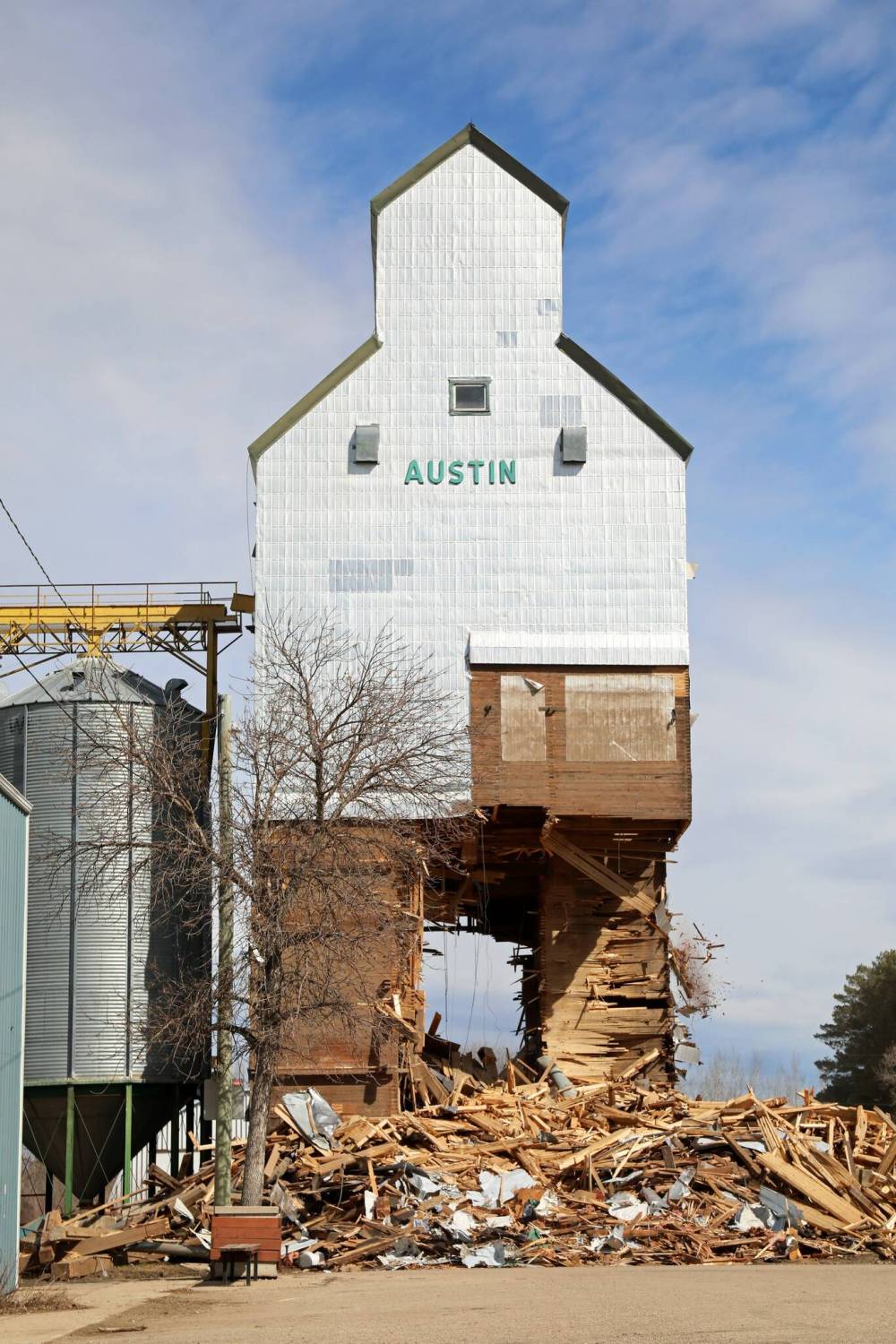
Goldsborough also researches and collects data about the elevator’s town, size, materials, patrons, staff and construction materials.
The effort is supported by a network of roughly 12 citizens who provide eyes and ears across the province, tipping Goldsborough off to updates and providing information to be documented. Citizens frequently submit photos for record at the Manitoba Historical Society, and then the photos are posted online.
The “countdown” is part of a larger project, called the Historic Sites of Manitoba. The entire effort is meant to acknowledge contributions from people of the past and highlight change and culture in Manitoba.
Goldsborough said the aim is to document the history of elevators and encourage people to become better observers and better recorders of those that remain.
“For example … you see a grain elevator, and you think to yourself, ‘There’s not as many elevators as there used to be. I should go and have a look at that one right now,” he said.
“I think that’s why people are just so bereft when their elevator comes down … It’s like taking the heart of a community and ripping it out.”
Many wooden grain elevators are obsolete and accumulating damage from the elements, deteriorating to the point that they will fall apart or present a public liability, Goldsborough said. This follows after the smaller, wooden elevators were replaced by more regional terminals that outsize the wooden elevators.
Because the elevators are symbolic, they are often associated with the history of the community, and act as a bridge to the past.
“I think most people acknowledge that elevators are sort of symbolic. I mean, they’re iconic for the prairies. You ask the average person what they think of, and especially if you ask people from away, what do they think of when they think of the Canadian prairies, they will often cite a grain elevator.”
This can lead community members to be sad to see them go, he said. It’s taken as a sign of the community’s decline, Goldsborough said.
“I think that’s why people are just so bereft when their elevator comes down, because they know in a very real way, it’s like taking the heart of a community and ripping it out, because you know, in most cases, the people say, ‘That elevator has been there my whole life.’”
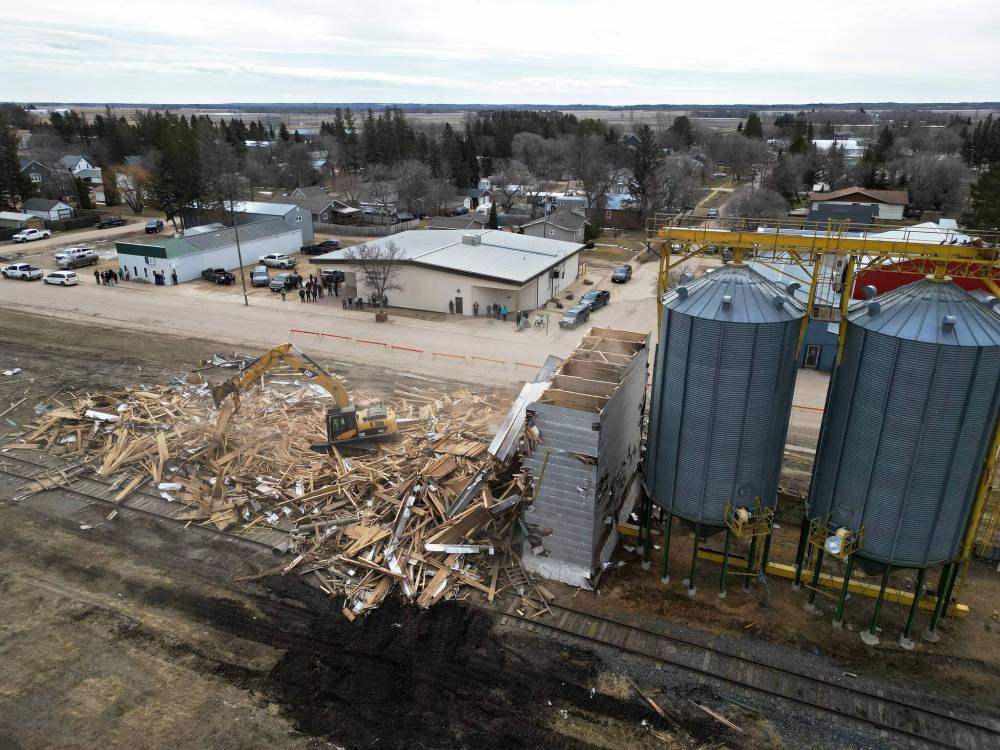
A crowd watches as the Austin grain elevator is demolished. (Tim Smith/The Brandon Sun files)
The demolition of the Austin grain elevator in April is a case in point, Municipality of North Norfolk Reeve Ed Heppner said. A noticable piece is missing from the community of old, he said — no longer is the community’s name posted in big letters on the side of the highway.
“That part, that’s true. You drive down the highway … you’re heading down the highway, and there was ‘Austin,’ but now it’s just a couple of steel bins, which are going to be gone as well.
“It is just an emotional loss, that’s all it is,” he said. “As a community, we got to move on and say, ‘Hey, we’ll build other stuff, and keep moving.’”
Heppner said that he hopes the community will get together and fundraise a memorial project about the elevator. That would be one positive way to go forward, he said.
“When the elevators were first built, you know, that was big progress. Well, what can we do now to make progress?” he said. “Bemoaning the fact, well, history moves on … Life moves on.”
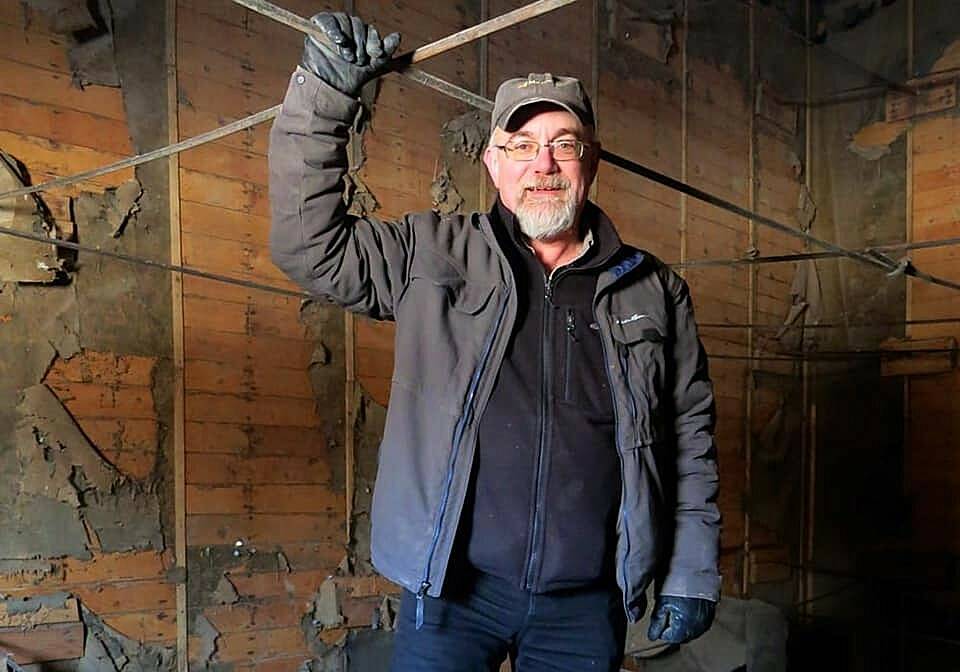
Gordon Goldsborough, head researcher of the Manitoba Historical Society. A dozen citizens around the province help him track the “countdown” of grain elevators as they’re demolished. He runs a publicly available map and database that shares that information. (Facebook/Janice Goldsborough)
Heppner said it would make the most sense to fund a memorial by donation, rather than a government project. When the area comes together, and pays homage to the people and landmarks of it’s past, that is more community-building than a government project that goes through council, he said.
The Manitoba Historical Society’s website has been updated to reflect the demolition at the Austin elevator, and lists a timeline of agents and buyers at the elevator from 1940 to 1998. A list of damage at the elevator was also documented, and photos were uploaded from the demolition day.
The Rural Municipality of St Clements, northeast of Winnipeg, posted on its social media in early May that it is preparing its Libau grain elevator for demolition. The area was fenced off, and the public was alerted to stay away from the area.
In the community of Elkhorn, however, a break from the pattern took place. A long neck construction crane was brought to the community in May to conduct repairs on the local grain elevator after it was damaged by a wind storm. The damage was repaired the same month, something that Goldsborough said is positive and encouraging to see.
Clayton Canart, reeve of that local Rural Municipality of Wallace Woodworth, did not respond to the Sun’s request for comment about the elevator repairs.

Manitoba Historical Society’s interactive map shows the location of roughly 111 grain elevators that still stand in Manitoba. (Manitoba Historical Society)
Goldsborough said he’ll monitor the story of Manitoba elevators as it unfolds.
To find the map of remaining Manitoba grain elevators, go online to mb1870.org/mhs-map-2/map and type “countdown” into the keyword search tool before refreshing the map.
» cmcdowell@brandonsun.com