
Manitoba detox law faces legal challenge
Advertisement
Read this article for free:
or
Already have an account? Log in here »
We need your support!
Local journalism needs your support!
As we navigate through unprecedented times, our journalists are working harder than ever to bring you the latest local updates to keep you safe and informed.
Now, more than ever, we need your support.
Starting at $15.99 plus taxes every four weeks you can access your Brandon Sun online and full access to all content as it appears on our website.
Subscribe Nowor call circulation directly at (204) 727-0527.
Your pledge helps to ensure we provide the news that matters most to your community!
To continue reading, please subscribe:
Add Brandon Sun access to your Free Press subscription for only an additional
$1 for the first 4 weeks*
- Enjoy unlimited reading on brandonsun.com
- Read the Brandon Sun E-Edition, our digital replica newspaper
*Your next Free Press subscription payment will increase by $1.00 and you will be charged $20.95 plus GST for four weeks. After four weeks, your payment will increase to $24.95 plus GST every four weeks.
Read unlimited articles for free today:
or
Already have an account? Log in here »
WINNIPEG — Manitoba’s former chief psychiatrist is challenging the constitutionality of a controversial law allowing the province to incarcerate intoxicated people for up to 72 hours, claiming that it will harm those suffering from mental illness or disabilities.
Dr. Jim Simm, an outspoken critic of the Protective Detention and Care of Intoxicated Persons Act, said Sunday that he is seeking leave from the Court of King’s Bench to challenge the law he says violates provisions of the Charter of Rights and Freedoms.
“We’re talking about human beings who are suffering,” Simm said. “They may be acting badly but to be putting them in solitary confinement — it’s just wrong.”
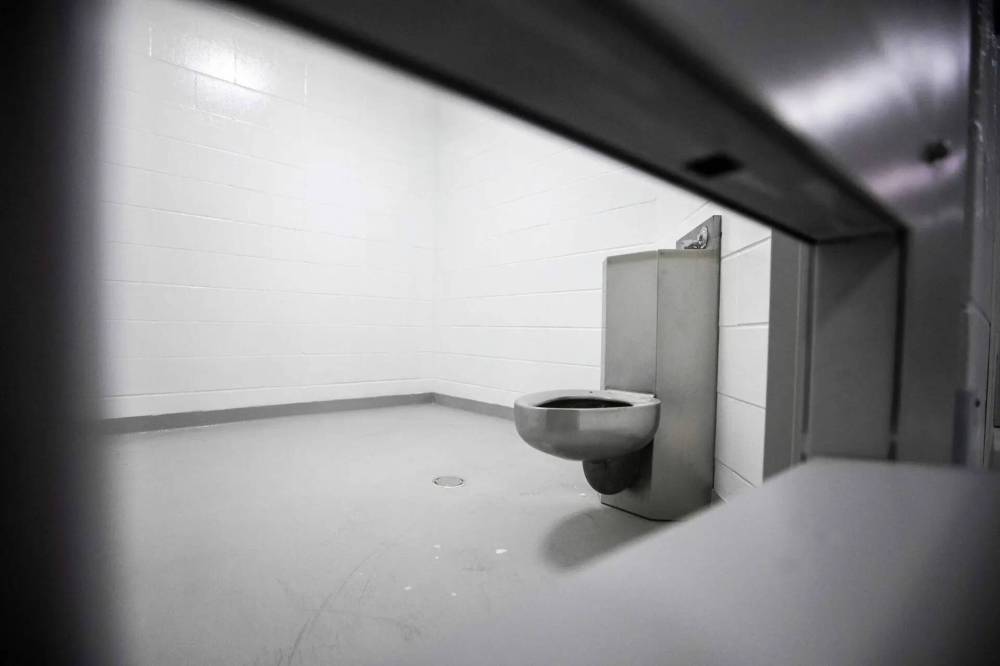
A room inside the 20-bed detox facility at 190 Disraeli Fwy. in Winnipeg. (Mikaela MacKenzie/Winnipeg Free Press files)
As it stands now, the legislation allows someone who appears intoxicated to be held for 24 hours at a “detention location,” and then held for up to 72 additional hours at a “preventative care centre.”
Last fall, the NDP government established such a facility when it opened a 20-bed detox centre at 190 Disraeli Fwy., for those under the influence of alcohol; starting in March, the government started allowing the facility to accept patients suffering from suspected drug-induced intoxication and psychosis.
Premier Wab Kinew has repeatedly referred to it as a “drunk tank for people that are high on drugs.” He said it was designed to take the most volatile patients suffering from a drug reaction out of hospital emergency rooms and off the street as quickly and safely as possible.
Health officials have said that anyone believed to be intoxicated by drugs should be assessed by an emergency-room physician and if it’s deemed appropriate, they can be transferred to the protective care/detox centre. There, it’s expected patients will be subject to regular monitoring, and reassessed by medical staff after 24 and 48 hours.
Simm, who has more than 25 years of clinical experience and spent two years as Manitoba’s top psychiatrist, said the criteria for admission to the detox centre is too subjective and does not account for the fact that initially, meth-induced psychosis is “indistinguishable” from schizophrenia or other acute mental illness. Although psychosis triggered by drugs can look very similar to an acute mental-health crisis, they require different treatment, he added.
Simm also said the law, as written, is very vague about how patients could be admitted to the preventative care facility. There is nothing in the law, Simm said, that would preclude a police officer from bypassing a hospital and taking someone directly to the detox centre. The law is also vague about what kind of health-care staff will be responsible for monitoring patients at the centre.
In general, Simm said, involuntary detention is not considered a best practice for helping someone addicted to drugs. He said recent research has shown periods of short, involuntary detox does little to reduce drug addiction and may make overdoses more likely when the person is eventually released.
“I think it’s a little bit of blustering by the government to make them look like they’re getting tough on crime. The better option, I think, would be to build more, proper, psychiatric wards that offer a full spectrum of treatment that could manage different levels of behaviour,” Simm said. “Seclusion is a very last resort.”
Contacted Sunday, a spokesman for the NDP government said it could not comment until it had studied Simm’s legal challenge.
» Winnipeg Free Press